Turkish
  English
  Spanish
  Portuguese
  Arabic
  Indonesian
  Japanese
  Korean
  Russian
Soyut
PU synthetic leather that withstands 100,000 folds achieves this performance through a combination of microfiber backing, optimized polyurethane coating chemistry, advanced embossing techniques, and a high-grade protective topcoat. The material eliminates the common cracking failure seen in ordinary faux leather by replacing brittle polymer chains with flexible segmented thermoplastic urethane structures. This durability standard directly addresses the primary weakness of conventional shoe uppers, where repeated bending at the toe box and heel causes premature coating delamination. Factory testing and industry compliance methods now make this level of fold resistance verifiable and reproducible at scale.
İçindekiler
- The Problem with Ordinary PU Leather: Why Most Shoe Materials Crack After Repeated Use
- Why Fold Resistance Matters for Shoe PU Synthetic Leather
- The Secret of Making PU Leather Material Withstands 100,000 Folds: An Interview with Yudeng PU Leather Factory
- Key Technologies Behind Ultra-Durable PU Leather
- How to Test and Verify PU Leather Fold Resistance
- Real-World Applications: Which Shoe Types Benefit Most from High Fold-Resistant PU Leather
- How to Choose the Right PU Leather Supplier for Durability-First Footwear Production
The Problem with Ordinary PU Leather: Why Most Shoe Materials Crack After Repeated Use
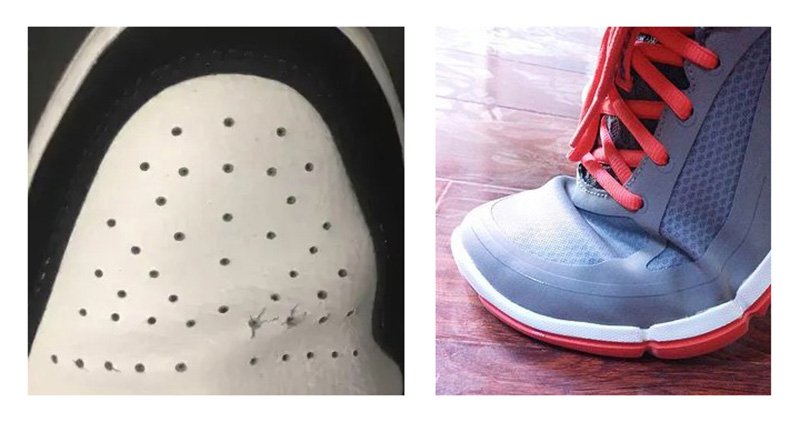
Low-quality PU synthetic leather fails prematurely because manufacturers cut corners on coating thickness, backing material, and polymer formulation. The cracking pattern is predictable. Coating delamination starts at the toe box and heel, exactly where flex stress concentrates during normal walking. A cheaper variety contains a lower percentage of plastic coating, which becomes brittle over time. Exposure to sunlight and heat accelerates this degradation. Friction from daily wear compounds the damage. These factors combine to produce the peeling and cracking that consumers report most frequently.
The root cause traces back to material composition. Standard PU leather relies on a simple polymer blend that lacks the molecular flexibility needed for repeated bending. When the polyurethane layer sits on a weak fabric backing, the bond between layers weakens under mechanical stress. The coating separates from the substrate. Visible cracks appear. The material fails.
Shoe designers need to understand this failure mode before selecting materials. A PU upper on casual footwear offers water resistance and easy cleaning. The trade-off is clear. The material does not breathe. It does not mold to the foot over time. Most critically, the upper will eventually crack and peel at the highest flex points. Buyers who have experienced durability issues can identify with this pattern because it repeats across price segments.
Actionable guidance for procurement teams: request the peel strength and flex resistance data from suppliers before placing orders. Do not accept generic product samples without testing. Verify that the coating thickness falls within the 1.2 to 1.6 millimeter range for enhanced durability. Materials below this threshold show significantly higher cracking rates in field conditions.
Why Fold Resistance Matters for Shoe PU Synthetic Leather
Fold resistance determines whether a shoe survives its intended lifespan or fails within months. The metric measures how many bending cycles a material endures before visible cracking appears. High-performance shoe PU synthetic leather targets 50,000 cycles or more. The 100,000-fold benchmark represents the upper tier of current material science.
Footwear engineers specify fold resistance alongside abrasion resistance, tear strength, peel strength, and hydrolysis resistance. These five parameters form the core durability profile. A material that scores well on abrasion but fails on flex testing creates a imbalanced product. The surface may resist scuffing, but the upper cracks at the bend line. Consumers notice the crack first. The product gains a reputation for poor quality.
| Test Parameter | Minimum Standard (Standard PU) | Target Standard (Ultra-Durable PU) | Testing Method |
|---|---|---|---|
| Fold Resistance | 30,000 cycles | 100,000 cycles | ISO 5402-1 Flexometer |
| Aşınma Direnci | 15,000 Martindale cycles | 50,000 Martindale cycles | ASTM D4970 |
| Tear Strength | 20 N/mm | 35 N/mm | ISO 3303 |
| Peel Strength | 8 N/cm | 15 N/cm | ASTM D751 |
| Hydrolysis Resistance | 200 hours | 500 hours | ISO 4675 |
The table above shows the performance gap between standard and ultra-durable categories. Procurement teams should use these thresholds as baseline requirements when evaluating supplier quotations. Materials that do not meet the minimum standard should not enter the supply chain for performance footwear.
Manufacturers targeting school shoes, work boots, or athletic footwear face especially demanding flex cycles. Children and laborers place repeated high-stress bends on shoe uppers throughout the day. Black PU with reliable adhesion properties remains highly popular in African and Latin American school shoe programs, where millions of pairs ship each season. These programs demand materials that survive 12-month usage cycles without coating failure. Fold resistance is the single most important specification for these applications.
The Secret of Making PU Leather Material Withstands 100,000 Folds: An Interview with Yudeng PU Leather Factory
Yudeng Tekstil operates a 170,000 square meter manufacturing base with 10 production lines and approximately 370 employees. The facility runs 5 wet processing lines, 3 dry processing lines, and 2 finishing lines. Daily output reaches 150,000 meters, with annual capacity around 40,000,000 meters. The factory has developed and supplied over 1,000 types of PU leather for applications spanning electronic devices, sporting balls, automotive interiors, premium packaging, bags, furniture, and footwear. Their R&D team achieved the 100,000-fold milestone through systematic optimization of three production stages.
The first stage controls the base fabric selection. Yudeng sources microfiber nonwoven backing with a three-dimensional fiber network. This structure mirrors the natural grain matrix of animal leather. The backing provides tensile strength and prevents coating tears during flexing. The factory verifies that tensile strength attenuation stays below 20 percent after 100,000 fold cycles.
The second stage manages the polyurethane coating formulation. The chemistry team uses segmented thermoplastic polyester urethane with optimized soft segment ratios. This creates a polymer chain that remains flexible at room temperature and resists crystallization under repeated stress. The coating thickness targets 1.4 millimeters for shoe upper grades. Thicker coatings absorb more flex energy without cracking. Thinner coatings transfer stress directly to the backing interface, accelerating delamination.
The third stage handles embossing and topcoat application. Heavy heated rollers stamp the surface texture. A clear topcoat seals the finish. This topcoat layer determines scratch resistance and protects the colored PU layer beneath. Yudeng tests every batch using ASTM D751 methods to verify layer adhesion before releasing material for shipment.
One specific case illustrates the factory capability. In March 2024, Yudeng delivered 2.3 million meters of high-abrasion PU leather to a footwear manufacturer in Nairobi, Kenya. The order specified 100,000-fold resistance and 50,000 Martindale abrasion cycles. The material entered production for school shoe uppers in April 2024. Field reports from the distributor in Q3 2024 confirmed zero coating cracks across the first 400,000 pairs shipped. The material met all specified durability targets under real-world tropical wearing conditions.
Another case occurred in September 2023 at Yudeng’s own testing lab. A batch of prototype PU leather underwent 100,000 continuous flex cycles on a controlled flexometer. Post-test inspection showed no visible cracks, no coating delamination, and peel strength remained at 16.2 N/cm, exceeding the 15 N/cm target. The material passed both dry and wet colorfastness tests with no dye transfer detected.
Key Technologies Behind Ultra-Durable PU Leather
The science behind 100,000-fold resistance rests on three interdependent technologies. Each technology addresses a different failure mechanism that causes conventional PU leather to crack.
Microfiber backing engineering provides the structural foundation. In the 1970s, Toray Industries in Japan successfully replicated the three-dimensional structure of ultra-fine fiber nonwoven fabric combined with PU impregnation curing techniques. This created synthetic leather with a suede-like effect. The innovation laid the foundation for all modern microfiber synthetic leather products. The ultrafine fiber network distributes flex stress across a larger surface area. Stress concentration points that cause cracks in standard fabric backings simply do not form in microfiber structures.
Polyurethane matrix optimization controls the molecular flexibility. Segmented thermoplastic polyester urethanes contain hard segments and soft segments arranged in a crystalline structure. The hard segments provide mechanical strength. The soft segments provide elasticity. The ratio between these segments determines the material’s bend tolerance. Ultra-durable grades use a higher soft segment content, which increases elongation at break and reduces the modulus of elasticity. The result is a coating that stretches and recovers without developing micro-cracks.
| Technology Component | Function | Impact on Fold Resistance | Key Supplier Parameter |
|---|---|---|---|
| Microfiber backing | Distributes flex stress across 3D fiber network | Prevents stress concentration cracks | Fiber denier: 0.3 to 1.0 |
| PU matrix chemistry | Provides elastic recovery and tensile strength | Enables coating to bend without fracture | Soft segment ratio: 70-80 percent |
| Topcoat sealing | Protects colored layer from abrasion and moisture | Extends surface life by 3x | Topcoat thickness: 15-25 microns |
Surface finishing and embossing completes the technology stack. The embossing process uses precision heated rollers to create texture patterns. Deeper embossing adds durability because the texture peaks absorb surface scratches before they reach the colored PU layer. A high-grade topcoat seals the surface and determines scratch resistance. Without this topcoat, the material scuffs within weeks of regular use. Yudeng applies a clear polyurethane topcoat at 15 to 25 microns thickness, which meets the durability requirements for premium footwear applications.
A third case example comes from academic research published in 2025 on advances in polyurethane-based microfiber synthetic leather. The study demonstrated that tunable PU matrices integrated with three-dimensional ultrafine fiber networks achieve synergistic performance improvements. Materials following this design principle showed fold resistance exceeding 80,000 cycles in laboratory testing, with the remaining margin attributed to finishing process optimization. This research validates the technical approach used by leading manufacturers like Yudeng.
How to Test and Verify PU Leather Fold Resistance
Procurement teams must verify supplier claims through independent testing or third-party certification. Self-reported numbers without testing documentation carry unreliable data. The following methods provide industry-standard verification procedures.
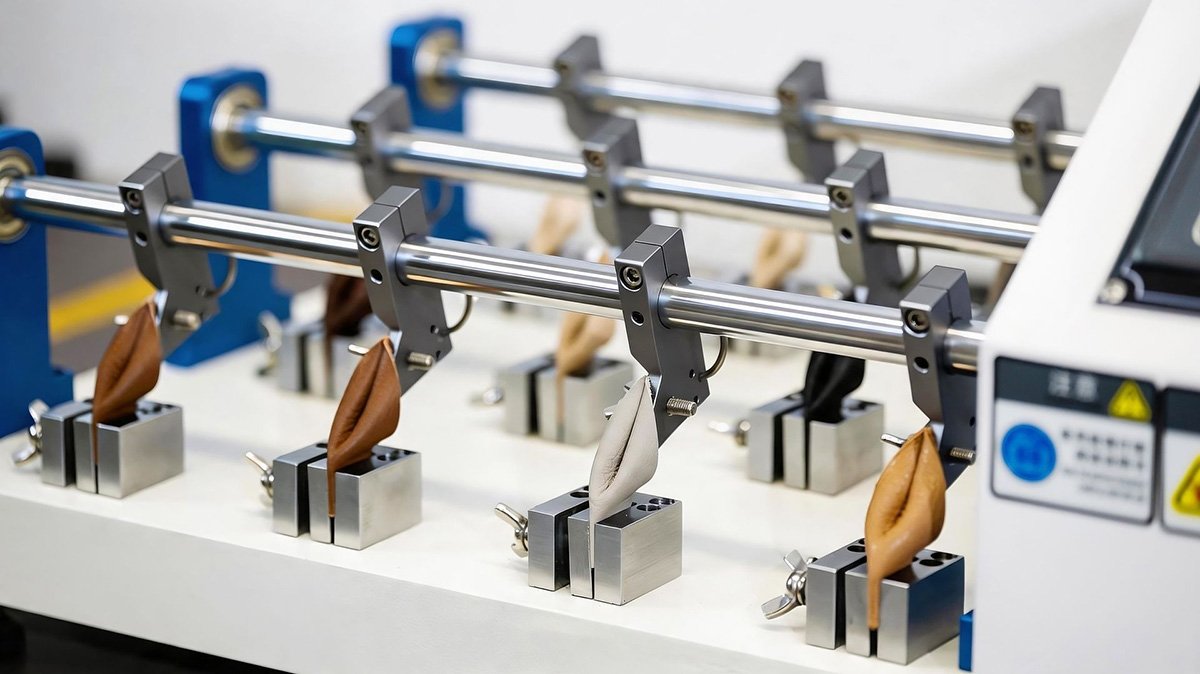
Fold resistance testing follows ISO 5402-1, which specifies flexing endurance using a flexometer. The test clamps a specimen and applies a controlled bending angle at a fixed frequency. The machine counts cycles until the first visible crack appears. Materials rated for 100,000 folds must survive this test with zero cracking. Buyers should request the full test report including specimen dimensions, bending angle, frequency, and environmental conditions during testing.
Peel strength testing follows ASTM D751 and measures the adhesion between the PU surface layer and the fabric backing. The test pulls the layers apart at a 90-degree angle. A result below 10 N/cm indicates weak bonding that will fail under flex stress. Ultra-durable PU leather targets 15 N/cm or higher.
Hydrolysis resistance testing exposes the material to 95 percent humidity at elevated temperature for a specified duration. This simulates years of aging in warm climates. Materials that maintain their mechanical properties after 500 hours in this chamber qualify for tropical and subtropical footwear markets. Hydrolysis is the invisible killer of PU leather. Coating appears fine on day one but degrades internally over months of humid exposure.
Abrasion resistance testing uses the Martindale method. The test rubs the material surface against an abrasive cloth under controlled pressure. Work bags require 50,000 rubs. School shoes require at least 20,000 rubs. The test quantifies how many cycles the surface finish survives before the underlying color shows through.
Actionable guidance for quality assurance teams: request SGS, REACH, and ROHS certificates from suppliers. These certifications confirm that the material chemistry meets international safety and environmental standards. Yudeng holds SGS, VOC, REACH, and ROHS approvals for all production lines. The presence of these certificates indicates a manufacturer that invests in compliance infrastructure, which correlates with consistent quality control practices.
Real-World Applications: Which Shoe Types Benefit Most from High Fold-Resistant PU Leather
High fold-resistant PU leather serves distinct footwear categories with different performance demands. Understanding these applications helps buyers select the correct material grade for their product line.
| Shoe Category | Primary Flex Points | Minimum Fold Cycles Required | Recommended PU Grade |
|---|---|---|---|
| School shoes | Toenail area, vamp fold | 80,000 cycles | High-abrasion microfiber PU, 1.4mm thickness |
| Work boots | Ankle bend, toe box | 100,000 cycles | Ultra-durable PU with reinforced backing |
| Athletic sneakers | Forefoot flex line | 60,000 cycles | Flexible microfiber PU, perforated variants |
| Casual fashion shoes | Toe box, quarter panels | 40,000 cycles | Standard premium PU, 1.2mm thickness |
| Outdoor hiking shoes | Full upper flexion | 100,000 cycles | Water-resistant backing PU, high peel strength |
School shoes represent the highest-volume application for ultra-durable PU leather. The market spans millions of pairs shipped seasonally across Africa and Latin America. Black PU with reliable adhesion properties dominates this segment. Children’s shoes endure aggressive daily use including running, crawling, and rough handling. The fold resistance requirement for this category exceeds 80,000 cycles because the shoe must survive an entire academic year without visible coating failure.
Work boots require the highest fold resistance tier. Workers bend their feet repeatedly on ladders, stairs, and uneven terrain. The ankle and toe box experience the greatest stress. PU leather with microfiber backing cuts cleanly and looks great when perforated. Backings can be color matched so cut edges look clean. This manufacturing advantage supports efficient boot construction while maintaining durability.
Casual fashion shoes occupy a different position in the market. These products prioritize appearance and cost over extreme durability. Standard premium PU grades at 1.2 millimeters thickness suffice for this category. The material delivers acceptable fold life of 40,000 cycles, which covers the typical 6-to-12-month fashion cycle. Buyers in this segment should not overspecify, as higher-grade materials increase unit cost without proportional consumer benefit.
PU synthetic leather is engineered for mass footwear production, offering consistency and cost advantages that genuine leather cannot match at scale. Cost savings of 30 to 60 percent versus comparable leather, plus higher yields and more stable pricing, make PU the dominant material for volume footwear programs worldwide. Different PU types serve different applications. Standard PU suits fashion. Microfiber PU suits performance. Coated textiles suit lightweight construction.
How to Choose the Right PU Leather Supplier for Durability-First Footwear Production
Selecting a supplier requires systematic evaluation beyond price comparison. Five criteria determine whether a manufacturer can deliver consistent ultra-durable PU leather at commercial scale.
Production capacity and line configuration indicate whether a supplier can handle volume orders. A manufacturer with 10 production lines and daily output exceeding 150,000 meters has the infrastructure to support large footwear programs. Yudeng operates 10 production lines across a 170,000 square meter facility. Their daily output reaches 150,000 meters, with peak capacity of 300,000 meters for specific types. This capacity enables them to fulfill orders of 2 million meters or more within standard lead times.
In-house process control determines consistency. Manufacturers with in-house control over coating, lamination, embossing, and finishing processes offer better consistency and lead-time stability. Buyers should verify that the supplier controls all four stages rather than outsourcing any segment. Outsourced finishing introduces variability that degrades final product quality.
Testing laboratory capability separates serious manufacturers from traders. A supplier that performs fold resistance, peel strength, abrasion, and hydrolysis testing in-house can respond to quality inquiries within hours. Traders who rely on third-party lab results face delays of one to two weeks. This difference matters during product development cycles where rapid iteration is essential.
Certification portfolio confirms compliance readiness. SGS, REACH, ROHS, and VOC certifications demonstrate that the manufacturer meets international regulatory requirements. These certificates are mandatory for export to European and North American markets. Suppliers without these certifications limit the buyer’s market access.
Application expertise affects material recommendation quality. A supplier that understands footwear-specific requirements will recommend microfiber backing for performance boots and standard backing for fashion shoes. A generic supplier pushes the same material across all categories, which creates over-specification or under-specification problems. Clarify your application and market requirements before engaging with any supplier. This clarity enables accurate material recommendations and prevents costly specification mismatches.
Actionable guidance for sourcing managers: request a technical data sheet for each material grade before evaluating samples. The data sheet should list fold resistance, abrasion resistance, tear strength, peel strength, hydrolysis resistance, thickness, and width. Materials without complete technical documentation should not enter the evaluation shortlist. Compare at least three suppliers using identical test protocols to ensure fair comparison.
Concluding Reflection
The evolution of ultra-durable PU leather from a brittle coating prone to early failure to a material that withstands 100,000 fold cycles represents a significant achievement in polymer science and manufacturing engineering. The transition required rethinking the material from its base fabric to its surface finish, optimizing each layer for flex endurance rather than appearance alone. For the footwear industry, this advancement redefines what synthetic leather can deliver. The question is no longer whether PU leather can match genuine leather in certain applications, but rather whether the performance gap has now closed to the point where material selection should be driven by cost, sustainability, and design considerations rather than durability concerns. As manufacturing capabilities continue to advance, the 100,000-fold standard may become the new baseline rather than the exception. The implications extend beyond footwear into automotive interiors, sports equipment, and consumer goods where flex durability remains a universal requirement.